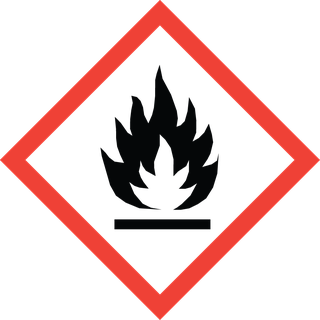
Flame pictogram (GHS02)
The flame pictogram (GHS02) is assigned to twelve hazard classes in UN GHS Rev.11: flammable gases; aerosols; chemicals under pressure; flammable liquids; flammable solids; self-reactive substances and mixtures; pyrophoric liquids; pyrophoric solids; self-heating substances and mixtures; substances and mixtures which, in contact with water, emit flammable gases; organic peroxides; and desensitized explosives. Of the 24 class and category rows below, 15 take Danger and nine take Warning. They call for 24 hazard statements (H206, H207, H208 and others). OSHA's Figure C.1 lists it for flammables, self-reactives, pyrophorics and more, and EU CLP Annex V gives it eleven entries. Under EU CLP it becomes optional when the exploding bomb applies, unless more than one of those pictograms is compulsory, and when it applies the gas cylinder becomes optional (Article 26(1)(a) and (e)).
Hazard classes and categories (UN GHS Rev.11)
| Hazard class | Category | Signal word | Hazard statements |
|---|---|---|---|
| Flammable gases (ch. 2.2) | Category 1A (including pyrophoric gas and chemically unstable gas A and B) H232 for pyrophoric gas; H230 or H231 for chemically unstable gas A or B, each together with H220. | Danger | |
| Flammable gases (ch. 2.2) | Category 1B | Danger | |
| Aerosols (ch. 2.3.1) | Category 1 | Danger | |
| Aerosols (ch. 2.3.1) | Category 2 | Warning | |
| Chemicals under pressure (ch. 2.3.2) | Category 1 Flame and gas cylinder | Danger | |
| Chemicals under pressure (ch. 2.3.2) | Category 2 Flame and gas cylinder | Warning | |
| Flammable liquids (ch. 2.6) | Categories 1, 2 H224 for Category 1, H225 for Category 2 | Danger | |
| Flammable liquids (ch. 2.6) | Category 3 | Warning | |
| Flammable solids (ch. 2.7) | Category 1 | Danger | |
| Flammable solids (ch. 2.7) | Category 2 | Warning | |
| Self-reactive substances and mixtures (ch. 2.8) | Type B Exploding bomb and flame | Danger | |
| Self-reactive substances and mixtures (ch. 2.8) | Types C, D | Danger | |
| Self-reactive substances and mixtures (ch. 2.8) | Types E, F | Warning | |
| Pyrophoric liquids (ch. 2.9) | Category 1 | Danger | |
| Pyrophoric solids (ch. 2.10) | Category 1 | Danger | |
| Self-heating substances and mixtures (ch. 2.11) | Category 1 | Danger | |
| Self-heating substances and mixtures (ch. 2.11) | Category 2 | Warning | |
| Substances and mixtures which, in contact with water, emit flammable gases (ch. 2.12) | Categories 1, 2 H260 for Category 1, H261 for Category 2 | Danger | |
| Substances and mixtures which, in contact with water, emit flammable gases (ch. 2.12) | Category 3 | Warning | |
| Organic peroxides (ch. 2.15) | Type B Exploding bomb and flame | Danger | |
| Organic peroxides (ch. 2.15) | Types C, D | Danger | |
| Organic peroxides (ch. 2.15) | Types E, F | Warning | |
| Desensitized explosives (ch. 2.17) | Categories 1, 2 H206 for Category 1, H207 for Category 2 | Danger | |
| Desensitized explosives (ch. 2.17) | Categories 3, 4 H207 for Category 3, H208 for Category 4 | Warning |
Symbol, signal word and hazard statements from UN GHS Rev.11, Annex 3 section 3.
By jurisdiction
US OSHA HCS
- Flammables
- Self-reactives
- Pyrophorics
- Self-heating
- Emits flammable gas
- Organic peroxides
- Desensitized explosives
EU CLP
- Flammable gases, categories 1A, 1B (2.2)
- Aerosols, categories 1, 2 (2.3)
- Flammable liquids, categories 1, 2, 3 (2.6)
- Flammable solids, categories 1, 2 (2.7)
- Self-reactive substances and mixtures, Types B to F (2.8)
- Pyrophoric liquids, category 1 (2.9)
- Pyrophoric solids, category 1 (2.10)
- Self-heating substances and mixtures, categories 1, 2 (2.11)
- Substances and mixtures which in contact with water emit flammable gases, categories 1, 2, 3 (2.12)
- Organic peroxides, Types B to F (2.15)
- Desensitised explosives, categories 1 to 4 (2.17)
Under Article 26(1)(e), if GHS02 applies, GHS04 is optional.
Canada WHMIS (HPR)
Schedule 3, item 1: Flame. Used for each HPR category (Parts 7 and 8) that GHS Rev.7 Annex 3, section 3 assigns this symbol to (s. 3(1)(c)), with the Schedule 3 pictogram in place of the symbol (s. 3(3)). Schedule 5 covers only the HPR-specific classes (s. 3(1)(d)). For chemicals under pressure the HPR uses GHS Rev.8 instead (s. 3(1)(c.1), (c.2)).
Mexico NOM-018-STPS-2015
Spanish name in NOM-018 Appendix B: “Llama”. Table B.3 lists the categories that take it.
Precedence rules that involve GHS02
UN GHS Rev.11, 1.4.10.5.3.1
- For substances and mixtures covered by the UN Model Regulations, precedence of symbols for physical hazards follows the Model Regulations. In workplace settings the competent authority may require all physical hazard symbols.
EU CLP, Article 26(1)
- (a) If GHS01 applies, GHS02 and GHS03 are optional, except where more than one of them is compulsory.
- (e) If GHS02 or GHS06 applies, GHS04 is optional.
Download
GHS02 EPS (vector) and PNG: copies of the US OSHA files, a US government work (licensing).
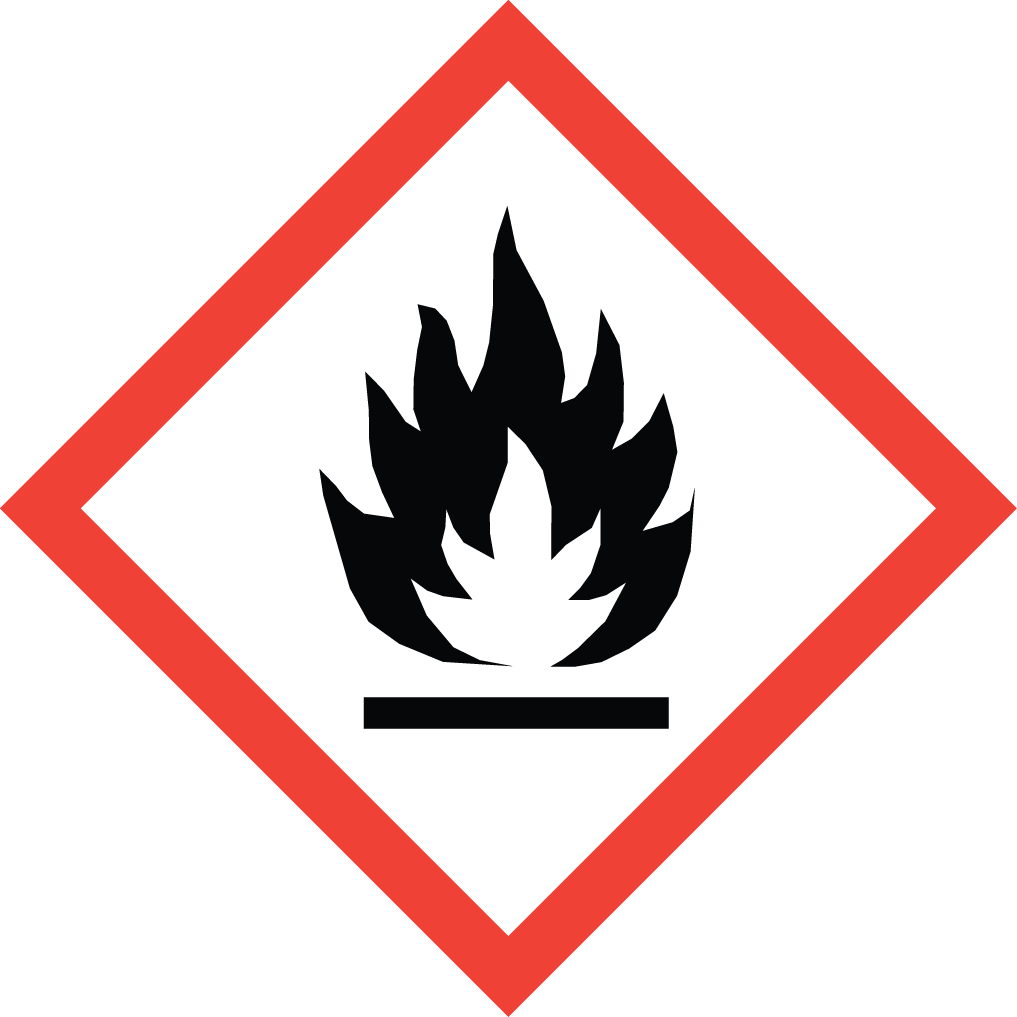
Sources: UN GHS Rev.11 Annex 3; 29 CFR 1910.1200 Appendix C; EU CLP Article 26 and Annex V; Canada HPR Schedules 3 and 5; NOM-018-STPS-2015 Appendix B. Sources and revision notes.
More free tools: GHS H and P statement lookup · OSHA HazCom 2024 compliance date checker
Related reading: MSDS vs SDS · GHS vs DOT classification · OSHA HazCom standard: SDS and labels