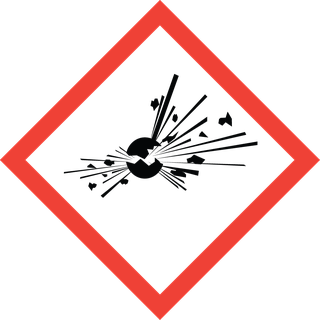
Exploding bomb pictogram (GHS01)
The exploding bomb pictogram (GHS01) is assigned to three hazard classes in UN GHS Rev.11: explosives, self-reactive substances and mixtures and organic peroxides. Of the seven class and category rows below, six take Danger and one takes Warning. They call for six hazard statements (H204, H209, H210 and others). OSHA's Figure C.1 lists it for explosives, self-reactives and organic peroxides, and EU CLP Annex V gives it three entries. Under EU CLP, when it applies, the flame and flame over circle pictograms become optional unless more than one of them is compulsory (Article 26(1)(a)).
Hazard classes and categories (UN GHS Rev.11)
| Hazard class | Category | Signal word | Hazard statements |
|---|---|---|---|
| Explosives (ch. 2.1) | Category 1 H210 and H211 are additional statements for explosives that are sensitive to initiation or whose sensitivity is not known (chapter 2.1, section 2.1.3). | Danger | |
| Explosives (ch. 2.1) | Category 2A | Danger | |
| Explosives (ch. 2.1) | Category 2B | Warning | |
| Self-reactive substances and mixtures (ch. 2.8) | Type A | Danger | |
| Self-reactive substances and mixtures (ch. 2.8) | Type B Exploding bomb and flame | Danger | |
| Organic peroxides (ch. 2.15) | Type A | Danger | |
| Organic peroxides (ch. 2.15) | Type B Exploding bomb and flame | Danger |
Symbol, signal word and hazard statements from UN GHS Rev.11, Annex 3 section 3.
By jurisdiction
US OSHA HCS
- Explosives
- Self-reactives
- Organic peroxides
OSHA uses unstable explosives and Divisions 1.1 to 1.6 (Appendix B.1.2), not the Rev.11 categories shown above. Unstable explosives and Divisions 1.1 to 1.4 take the exploding bomb, except that no pictogram is required for Division 1.4S small arms ammunition (C.4.14, note 1, 91 FR 579). Divisions 1.5 and 1.6 have no pictogram (Appendix C.4.14, as corrected at 91 FR 562, 577 to 581).
EU CLP
- Unstable explosives; explosives of Divisions 1.1, 1.2, 1.3, 1.4 (section 2.1)
- Self-reactive substances and mixtures, Types A, B (2.8)
- Organic peroxides, Types A, B (2.15)
The EU text still uses the older explosives scheme (unstable explosives and Divisions 1.1 to 1.6). Explosives of Divisions 1.5 and 1.6 need no pictogram (Annex V, 1.6). Under Article 26(1)(a), if GHS01 applies, GHS02 and GHS03 are optional unless more than one of them is compulsory.
Canada WHMIS (HPR)
Schedule 3, item 3: “Exploding bomb”. Used for self-reactive substances and mixtures and organic peroxides, Types A and B. The HPR has no explosives hazard class: Part 7, Subpart 1 (s. 7.1) is reserved.
Mexico NOM-018-STPS-2015
Spanish name in NOM-018 Appendix B: “Bomba explotando”. Table B.3 lists the categories that take it.
NOM-018 Table B.3: unstable explosives and Divisions 1.1 to 1.4 (“Explosivos (inestable y divisiones 1.1 al 1.4)”), not the Rev.11 categories shown above.
Precedence rules that involve GHS01
UN GHS Rev.11, 1.4.10.5.3.1
- For substances and mixtures covered by the UN Model Regulations, precedence of symbols for physical hazards follows the Model Regulations. In workplace settings the competent authority may require all physical hazard symbols.
EU CLP, Article 26(1)
- (a) If GHS01 applies, GHS02 and GHS03 are optional, except where more than one of them is compulsory.
Download
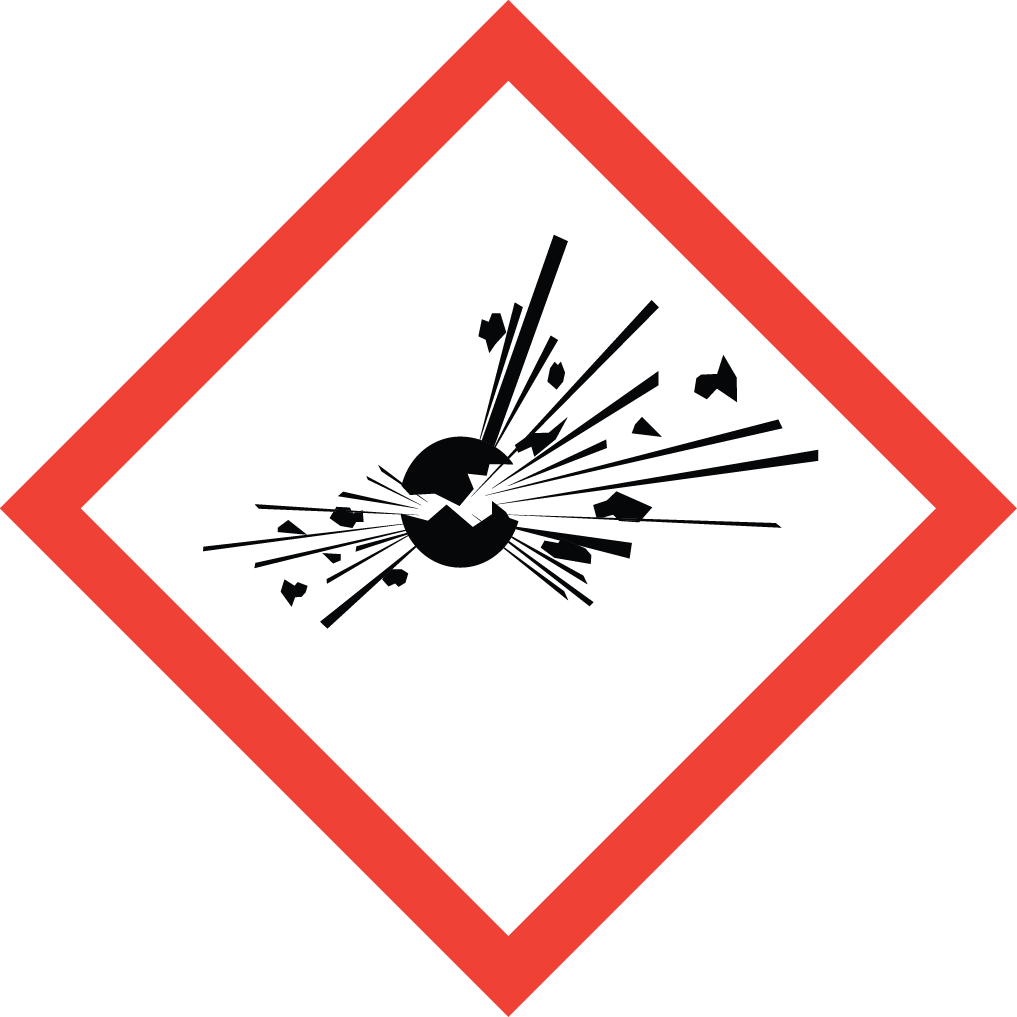
GHS01 EPS (vector) and PNG: copies of the US OSHA files, a US government work (licensing).
Sources: UN GHS Rev.11 Annex 3; 29 CFR 1910.1200 Appendix C; EU CLP Article 26 and Annex V; Canada HPR Schedules 3 and 5; NOM-018-STPS-2015 Appendix B. Sources and revision notes.
More free tools: GHS H and P statement lookup · OSHA HazCom 2024 compliance date checker
Related reading: MSDS vs SDS · GHS vs DOT classification · OSHA HazCom standard: SDS and labels