Short answer: MSDS is the old name, SDS is the current one
An MSDS (material safety data sheet) and an SDS (safety data sheet) are the same kind of document. Both tell workers and emergency responders what a chemical is, what its hazards are, and how to handle it safely. The difference is that "SDS" is the current term under OSHA's Hazard Communication Standard, and an SDS follows a fixed 16 section format in a set order.
If your files still say "Material Safety Data Sheet" at the top, that is usually a sign the sheet was written under the older rules. It is worth a second look, and often a request to the supplier for a current version.
Why the name changed
In 2012, OSHA revised its Hazard Communication Standard to align with the Globally Harmonized System of Classification and Labelling of Chemicals (GHS). The final rule was published in the Federal Register on March 26, 2012. Among other changes, it specified a format for safety data sheets, and the term "safety data sheet" replaced "material safety data sheet."
OSHA updated the standard again in 2024. The core point for this article has not changed: the current rule calls for safety data sheets with set sections and headings, in a set order.
What is different in the format
Under the older rules, an MSDS had to contain certain information, but there was no required order. Two suppliers could put the same data in very different places.
Today, 29 CFR 1910.1200(g)(2) requires the safety data sheet to be in English (employers may keep copies in other languages too) and to include these section numbers and headings, in this order:
Identification
Hazard(s) identification
Composition/information on ingredients
First-aid measures
Fire-fighting measures
Accidental release measures
Handling and storage
Exposure controls/personal protection
Physical and chemical properties
Stability and reactivity
Toxicological information
Ecological information
Disposal considerations
Transport information
Regulatory information
Other information, including date of preparation or last revision
Appendix D of the standard sets out what belongs under each heading. The fixed order means a reader can go straight to Section 8 for protective equipment or Section 4 for first aid on any sheet, from any supplier.
Other changes that came with it
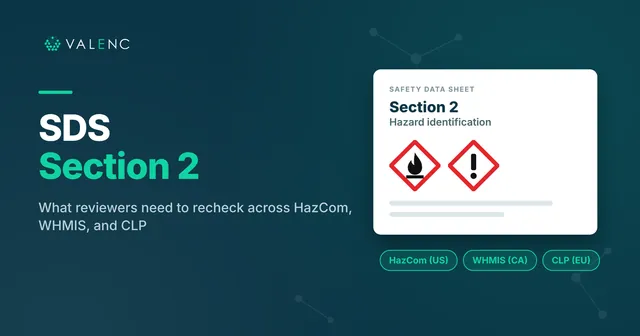
The move to SDS was part of a larger shift. Hazards are now classified using GHS based criteria, and labels carry standard elements: a signal word, pictograms, hazard statements, and precautionary statements. Section 2 of the SDS carries the same classification and label elements. We cover labels in more detail in a separate article, and our post on SDS Section 2 across HazCom, WHMIS, and CLP covers how that section differs by market.
For the wider HazCom picture, see our guide to the OSHA HazCom standard, SDSs, and labels.
Why old MSDS files are still a problem
Most SDS libraries were built over many years. They tend to hold a mix of:
sheets written before the switch to the SDS format
sheets with sections in a different order, or missing sections
sheets from suppliers who have not sent an update in years
duplicate versions of the same product, with no clear way to tell which is current
The risks are practical. An old sheet may be missing hazard information that a current classification would include. Without a standard layout, it is harder for workers to find what they need quickly. And a library full of mixed formats is hard to search, which makes simple questions slow to answer, like "which of our products contain this substance?"
The standard also expects sheets to stay current. Under 1910.1200(g)(5), when the company preparing the SDS becomes newly aware of significant information about a chemical's hazards, or ways to protect against them, that information must be added to the SDS within three months.
A simple check for your library
You do not need a big project to get started. Pull a sample of your sheets and check each one:
The title. Does it say "Material Safety Data Sheet"? Flag it.
The sections. Are there 16 sections, in the order listed above?
The revision date. When was it last revised? Very old dates are worth a follow-up.
The supplier. Is the supplier still current, and is this their latest version?
The request. For anything flagged, ask the supplier for their current SDS.
Keep a simple list of what you flagged and when you asked. If you are unsure whether a specific sheet is acceptable, check OSHA's current text of 1910.1200 and ask your regulatory contact.
If your library is large
A sample check works for a few dozen sheets. It gets slow when you have hundreds or thousands, spread across shared drives, email, and binders.
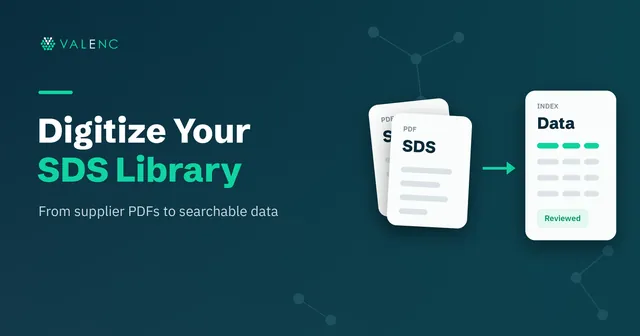
That is where indexing helps. An index pulls the key fields out of each sheet (product name, supplier, revision date, and more) into one searchable list, so old and outdated sheets stand out. Valenc reads each SDS and reports 98%+ field accuracy with per-field confidence, so you can see which fields need a human look. Read more about SDS indexing on Valenc, or our guide on how to digitize your SDS library.
FAQ
Is an old MSDS still valid?
The current OSHA standard calls for safety data sheets in the 16 section format, and employers must have a safety data sheet for each hazardous chemical they use. If you have an older MSDS on file for a chemical you still use, ask the supplier for a current SDS. For a firm answer on a specific sheet, check OSHA's current text and your regulatory contact.
Are MSDS and SDS the same document?
They are the same kind of document. SDS is the current name, and it follows a set 16 section format.
How many sections does an SDS have?
Sixteen, in a set order, starting with Identification and ending with Other information.
Who writes the SDS?
Under 1910.1200(g)(1), chemical manufacturers and importers must obtain or develop a safety data sheet for each hazardous chemical they produce or import. Employers must have one in the workplace for each hazardous chemical they use.
This article explains the regulation in plain terms. It is not legal advice. Confirm against the current text of 29 CFR 1910.1200 before you rely on it.
Got a library full of old MSDS files? Valenc will index up to 100 of your SDSs free. The offer is open to any chemical manufacturer through December 31, 2026. Send your files through our secure portal, and we send back an index of your files within 3 business days of receiving them.