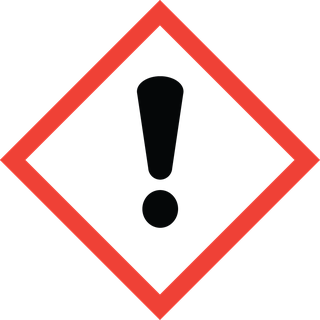
Exclamation mark pictogram (GHS07)
The exclamation mark pictogram (GHS07) is assigned to eight hazard classes in UN GHS Rev.11: explosives; acute toxicity; skin corrosion/irritation; serious eye damage/eye irritation; skin sensitization; specific target organ toxicity, single exposure; hazardous to the ozone layer; and hazardous by contributing to global warming. Every one of the eight rows below takes the signal word Warning. They call for eleven hazard statements (H204, H302, H312 and others). OSHA's Figure C.1 lists it for irritant, dermal sensitizer, acute toxicity (harmful) and more, and EU CLP Annex V gives it six entries. Several precedence rules remove it: the skull and crossbones, the corrosion pictogram (for skin or eye irritation) and the health hazard pictogram (for respiratory sensitization) each take its place for the overlapping hazards.
Hazard classes and categories (UN GHS Rev.11)
| Hazard class | Category | Signal word | Hazard statements |
|---|---|---|---|
| Explosives (ch. 2.1) | Category 2C | Warning | |
| Acute toxicity (oral, dermal, inhalation) (ch. 3.1) | Category 4 | Warning | |
| Skin corrosion/irritation (ch. 3.2) | Category 2 | Warning | |
| Serious eye damage/eye irritation (ch. 3.3) | Category 2/2A | Warning | |
| Skin sensitization (ch. 3.4) | Category 1, 1A, 1B | Warning | |
| Specific target organ toxicity, single exposure (ch. 3.8) | Category 3 Respiratory tract irritation (H335) or narcotic effects (H336) | Warning | |
| Hazardous to the ozone layer (ch. 4.2) | Category 1 | Warning | |
| Hazardous by contributing to global warming (ch. 4.2) | Category 1 Added in GHS Rev.11 | Warning |
Symbol, signal word and hazard statements from UN GHS Rev.11, Annex 3 section 3.
By jurisdiction
US OSHA HCS
- Irritant
- Dermal sensitizer
- Acute toxicity (harmful)
- Narcotic effects
- Respiratory tract irritation
- Hazard not otherwise classified (non-mandatory)
Wording as in Figure C.1 (as corrected at 91 FR 574). Explosives Category 2C exists only in UN GHS Rev.11. No OSHA, EU, Canada or Mexico label uses the exclamation mark for explosives.
C.2.3.3: the exclamation mark is permitted, not required, for an HNOC, with the words "Hazard Not Otherwise Classified" or "HNOC" below it. OSHA does not require labeling for HNOC hazards (89 FR 44144 preamble).
EU CLP
- Acute toxicity (oral, dermal, inhalation), category 4 (3.1)
- Skin irritation, category 2 (3.2)
- Eye irritation, category 2 (3.3)
- Skin sensitisation, categories 1, 1A, 1B (3.4)
- STOT single exposure, category 3: respiratory tract irritation, narcotic effects (3.8)
- Hazardous to the ozone layer, category 1 (5.1)
Article 26(1)(b) to (d) say when GHS07 must not appear next to GHS06, GHS05 or GHS08.
Canada WHMIS (HPR)
Schedule 3, item 7: Exclamation mark. Used for each HPR category (Parts 7 and 8) that GHS Rev.7 Annex 3, section 3 assigns this symbol to (s. 3(1)(c)), with the Schedule 3 pictogram in place of the symbol (s. 3(3)). Schedule 5 covers only the HPR-specific classes (s. 3(1)(d)).
Mexico NOM-018-STPS-2015
Spanish name in NOM-018 Appendix B: “Signo de exclamación”. Table B.3 lists the categories that take it.
NOM-018 uses explosives Divisions 1.1 to 1.4 (Table B.3) and has no explosives Category 2C.
Precedence rules that involve GHS07
UN GHS Rev.11, 1.4.10.5.3.1
- If the skull and crossbones applies, the exclamation mark should not appear.
- If the corrosive symbol applies, the exclamation mark should not appear where it is used for skin or eye irritation.
- If the health hazard symbol appears for respiratory sensitization, the exclamation mark should not appear where it is used for skin sensitization or for skin or eye irritation.
US OSHA, Appendix C, C.2.1 and C.2.3.4
- If the skull and crossbones is included, the exclamation mark shall not appear where it is used for acute toxicity.
- If the corrosive pictogram is included, the exclamation mark shall not appear where it is used for skin or eye irritation.
- If the health hazard pictogram is included for respiratory sensitization, the exclamation mark shall not appear where it is used for skin sensitization or for skin or eye irritation.
EU CLP, Article 26(1)
- (b) If GHS06 applies, GHS07 shall not appear.
- (c) If GHS05 applies, GHS07 shall not appear for skin or eye irritation.
- (d) If GHS08 applies for respiratory sensitisation, GHS07 shall not appear for skin sensitisation or for skin and eye irritation.
Canada HPR, s. 3.6(3)
- If the skull and crossbones is required, the exclamation mark for acute toxicity does not apply.
- If the corrosion symbol is required, the exclamation mark for skin or eye irritation does not apply.
- If the health hazard symbol is required for respiratory sensitization, the exclamation mark for skin sensitization or skin or eye irritation does not apply.
Mexico NOM-018-STPS-2015, 10.6
- The exclamation mark is not used for health hazards when the skull and crossbones is used; when corrosion is used for skin or eye irritation; or for respiratory sensitization, even if the product is also a skin sensitizer or skin or eye irritant (as worded in 10.6).
Download
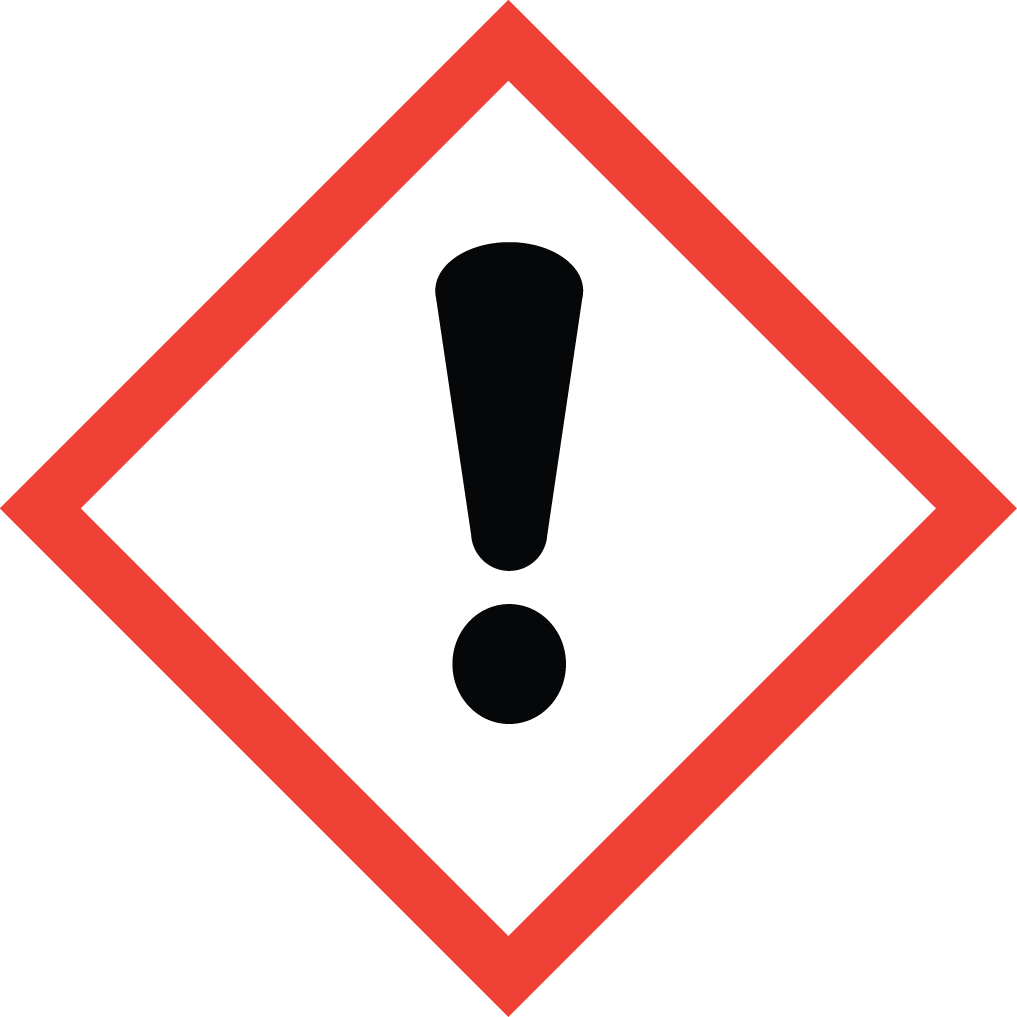
GHS07 EPS (vector) and PNG: copies of the US OSHA files, a US government work (licensing).
Sources: UN GHS Rev.11 Annex 3; 29 CFR 1910.1200 Appendix C; EU CLP Article 26 and Annex V; Canada HPR Schedules 3 and 5; NOM-018-STPS-2015 Appendix B. Sources and revision notes.
More free tools: GHS H and P statement lookup · OSHA HazCom 2024 compliance date checker
Related reading: MSDS vs SDS · GHS vs DOT classification · OSHA HazCom standard: SDS and labels