A product sold in both Great Britain and the EU requires two safety data sheets. While both share the same 16 sections and much of the same data, they are governed by different regulations and may have different classifications for the same formula. The key challenge for a small regulatory team is producing both without manually maintaining separate documents.
The solution is to maintain a single product record and apply each jurisdiction’s rules to it. This guide outlines the common elements, the nine key differences, and a six-step process to create both SDSs from one record.
This article is informational, not legal advice.
Two rulebooks since Brexit
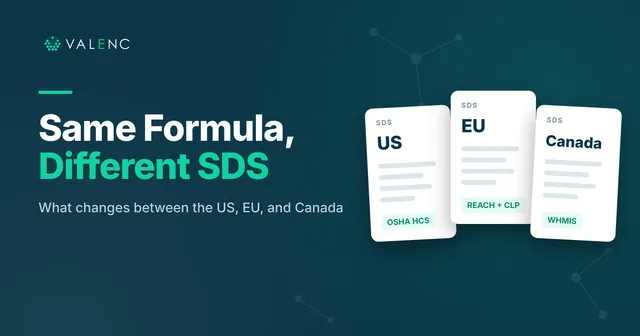
In the EU, the SDS follows REACH Annex II (as rewritten by Regulation (EU) 2020/878), and classification follows the CLP Regulation. In Great Britain (England, Scotland and Wales), the SDS follows UK REACH, and classification follows GB CLP, including the GB mandatory classification list. Northern Ireland still applies EU REACH and EU CLP.
As a result, a product sold throughout the UK may require both versions: a GB SDS for Great Britain and an EU-format SDS for Northern Ireland. For the full requirements of each, see our guides to UK SDS requirements and EU SDS requirements.
What the two SDSs share
Most requirements are shared. These elements should be included in a single product record:
- The formulation: every ingredient, its CAS number and its concentration.
- The underlying data: physical and chemical properties, toxicological and ecological data.
- The structure: the 16 sections and the required content of each section.
- The supply rules. In both markets you provide the SDS free of charge, on paper or electronically, no later than the first delivery. You update it without delay when you learn something new about the hazards or how to control them. You send the update to every customer you supplied in the previous 12 months.
Nine places where a GB SDS and an EU SDS differ
| Topic | Great Britain | EU |
|---|---|---|
| Supplier in Section 1 | A GB-based manufacturer, importer, downstream user or distributor | An EU-based supplier |
| Language | English | An official language of each country of sale |
| Classification | GB CLP and the GB mandatory classification list | EU CLP and Annex VI harmonised classifications |
| New hazard classes | Not adopted (endocrine disruptor, PBT/vPvB, PMT/vPvM) | Required on a phased schedule to May 1, 2028 |
| Section 3 | UK REACH registration numbers | EU REACH registration numbers |
| Section 8 | GB Workplace Exposure Limits from HSE’s EH40 | EU indicative limits and the national limits of each country |
| Section 15 | GB regulations, such as COSHH and UK REACH | EU regulations, such as REACH authorisation and restriction |
| UFI and poison centre notification | Not required | Required for mixtures classified for health or physical hazards |
| Confidential ingredient names | Alternative chemical name requested from HSE | Alternative chemical name requested from ECHA |
The classification row is critical. GB and the EU now have separate mandatory classifications, so a substance may be classified differently in each market. Simply changing the supplier address on an EU SDS does not make it a GB SDS.
A six-step workflow from one record
Build the product record once. Enter the full composition, including CAS numbers, exact concentrations, and all physical, toxicological, and ecological data. This record serves as the single source for all versions.
Classify independently for each market. Run the formulation against EU CLP and GB CLP separately. Record any differences and their reasons for reviewer transparency.
Add jurisdiction-specific data. For each market, attach the legal supplier, registration numbers, exposure limits, and Section 15 regulatory information as data fields, not as text within the document.
Set the appropriate languages. A GB SDS must be in English. An EU SDS must be in an official language of each country where the product is supplied, using official CLP wording for hazard and precautionary statements.
Generate labels from the same classification record. This ensures label information remains consistent with the SDS.
Manage changes centrally. When a formulation, supplier SDS, or rule changes, flag all affected versions for review and assign each a revision date.
Dates to keep in view
- EU new hazard classes (Regulation (EU) 2023/707). Substances already on the market had to be classified under the new classes by November 1, 2026. New mixtures have been in scope since May 1, 2026. Existing mixtures have until May 1, 2028.
- EU label formatting. The revised CLP (Regulation (EU) 2024/2865) introduced new label formatting and advertising rules. Regulation (EU) 2025/2439 postponed most of these to January 1, 2028. The new hazard classes remain in effect as scheduled.
- GB notification. Since May 21, 2026, manufacturers and importers no longer notify HSE of substance classification and labelling for the GB market. Northern Ireland businesses supplying Northern Ireland must still notify ECHA.
- GB mandatory classifications are moving to a new adoption system. The current system will remain in place during this period.
Five mistakes to avoid
- Relabelling an EU SDS as a GB SDS without reclassifying under GB CLP.
- Listing EU or national exposure limits in Section 8 of a GB SDS instead of GB Workplace Exposure Limits.
- Including new EU hazard classes on a GB SDS, where they do not apply.
- Including EU REACH registration numbers in Section 3 of a GB SDS.
- Forgetting Northern Ireland, which needs the EU-format SDS.
How Valenc handles the EU and the UK
Valenc generates GB and EU SDSs from a single product record.
- Separate classification. The rules engine applies GB CLP and EU CLP independently and shows where the results differ.
- The right limits in Section 8. GB Workplace Exposure Limits for Great Britain, EU and national limits for each EU country of sale.
- Labels from the same record. GB and CLP labels are generated from the same classified record as the SDS.
- Languages. Hazard and precautionary statements come from a curated phrase library in more than 25 languages.
- One change, every version flagged. When a formulation or rule changes, every affected US, GB and EU SDS is flagged for review.
- Your approval before publication. Your team reviews and approves each SDS before release.
View supported regions and languages, or see how SDS authoring works from one record.
Frequently asked questions
Can I use my EU SDS in Great Britain?
Not as it stands. A GB SDS needs a GB supplier, GB CLP classification, GB Workplace Exposure Limits, UK REACH registration numbers and GB regulatory information.
Does a GB SDS need a UFI?
No. Great Britain does not require poison centre notification. Northern Ireland follows the EU and does.
Which SDS does Northern Ireland need?
The EU-format SDS. Northern Ireland applies EU REACH and EU CLP.
Can one record really produce both?
Yes, if classification, exposure limits, supplier details and regulatory information are held as data for each market instead of written content in a document. The formulation and the underlying data are entered once.
Sources
- Changes to the GB CLP Regulation, HSE
- Safety data sheets, HSE
- REACH safety data sheets, HSENI
- Regulation (EC) No 1907/2006 (REACH), Article 31 and Annex II, as amended by Regulation (EU) 2020/878
- Regulation (EC) No 1272/2008 (CLP), with Regulations (EU) 2023/707, 2024/2865 and 2025/2439
See a GB SDS and an EU SDS built from one of your own products.