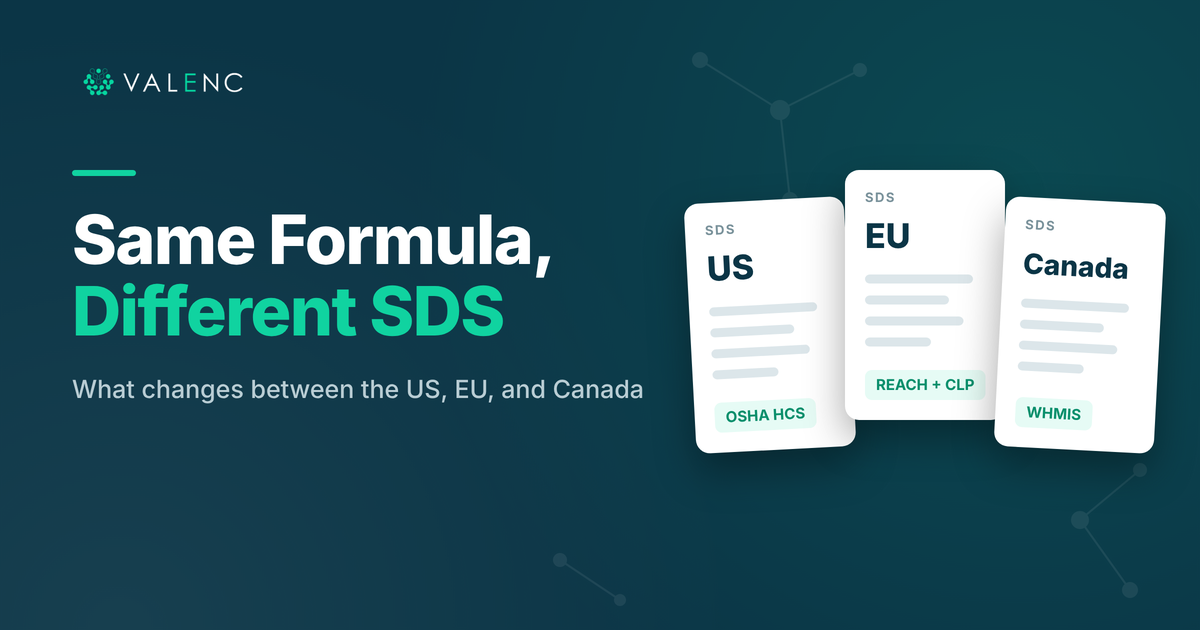
The same chemical formula can lead to three different safety data sheets, each of which can still be correct.
The United States, European Union, and Canada all use hazard communication systems based on GHS and each uses a 16-section SDS format. While the documents may look similar, the rules behind them are different.
In the United States, the relevant framework is OSHA’s Hazard Communication Standard. In the EU, SDS requirements come from REACH Annex II while classification and labelling are governed by CLP. In Canada, workplace hazardous products are governed by the Hazardous Products Act and Hazardous Products Regulations under WHMIS. Each jurisdiction decides which GHS building blocks to adopt, what extra requirements to add, and how information must be presented.
The practical rule
Treat the formula as shared source data, not the SDS as a universal master document. Classification, language, Section 2, ingredient disclosure, exposure information, and Sections 12 to 15 can all change by market.
US vs EU vs Canada SDS requirements at a glance
| Difference | United States | European Union | Canada |
|---|---|---|---|
| Regulatory framework | OSHA HCS 2024 | REACH Annex II + CLP | HPA/HPR under WHMIS |
| GHS alignment | Primarily GHS Rev. 7, with selected Rev. 8 provisions | GHS-based CLP plus EU-specific hazard classes and adaptations | GHS Rev. 7, plus Chemicals Under Pressure from Rev. 8 |
| Required language | English | Official language(s) of the Member State unless that Member State provides otherwise | English and French |
| 16-section structure | Yes | Yes | Yes |
| Sections 12 to 15 | Headings included; OSHA does not enforce their information requirements | Required under REACH Annex II | Headings required; specific content may be omitted |
| Classification system | OSHA HCS | EU CLP | Canadian HPR |
| One obvious local issue | HCS 2024 classification and SDS updates | EU-specific hazards, REACH/CLP content and Member-State language | Bilingual SDS and HPR-specific ingredient disclosure |
The shared 16-section format is only the shell
OSHA requires an SDS with the standard section numbers and headings in English. Under the current HCS regulatory text, Sections 1 through 11 and Section 16 contain OSHA-mandated information. Sections 12 through 15 remain in the GHS sequence, but OSHA states that it does not enforce their information requirements because those topics fall outside OSHA’s jurisdiction.
Canada also requires the standardized 16-heading format. The important difference is that under the HPR, the headings for Sections 12 through 15 must appear but the specific content under those headings may be omitted. HPR subsection 4(2) makes that distinction explicit.
The EU takes a different approach. REACH Annex II specifies the 16 sections and the information to be compiled under them. Environmental, disposal, transport, and regulatory content are part of the EU SDS requirements rather than simply preserved as empty GHS headings.
This means that even before you consider classification differences, a document that only meets U.S. requirements might not be complete enough for the EU.
Difference 1: the hazard classification itself may change
The biggest difference happens before the SDS is even written. An SDS shows the classification; it does not decide it. If the classification rules are different, Section 2 and the rest of the hazard information can change, even if the formula stays the same.
OSHA’s 2024 HCS update aligns the U.S. system primarily with GHS Revision 7, with selected provisions from Revision 8. The updated standard also includes U.S.-specific implementation choices and changes to physical and health hazard criteria.
Canada’s amended HPR is also based on GHS Revision 7, with the Chemicals Under Pressure class adopted from Revision 8.
The EU is not simply another copy of GHS Rev. 7. CLP has EU-specific adaptations, including new hazard classes for endocrine disruption, PBT/vPvB, and PMT/vPvM. For mixtures first placed on the EU market on or after May 1, 2026, those new hazard classes apply as relevant. The transition dates are set in CLP as amended by Regulation (EU) 2023/707: mixtures from May 1, 2026, with mixtures already on the market before then given until May 1, 2028.
This means a mixture might need a different Section 2 in the EU than in the U.S. or Canada. The formula stays the same, but the rules are different.
For the classification side of the workflow, see Valenc’s GHS classification page.
Difference 2: the language obligation is completely different
Language is one of the most obvious differences, and it is also easy to get wrong in practice.
United States: English is required
OSHA requires the chemical manufacturer or importer preparing the SDS to ensure that it is in English. Employers may maintain additional copies in other languages, but the required SDS is English.
Canada: both English and French
Canadian WHMIS requires SDS information elements in both official languages (HPR section 6.2).
EU: the market determines the language
REACH requires the SDS to be supplied in an official language of the Member State where the substance or mixture is placed on the market, unless that Member State provides otherwise (REACH Article 31(5)).
In practice, using only one English SDS file is not enough for a global language strategy.
See the regions and languages Valenc supports.
Difference 3: Section 2 cannot be copied from market to market
Section 2 is where classification becomes visible to the SDS user. It is also where jurisdiction differences are most likely to be immediately obvious.
A U.S. SDS must reflect classification under OSHA HCS. A Canadian SDS must reflect classification under the HPR. An EU SDS must give the CLP classification and corresponding label elements, while also addressing EU-specific other-hazards requirements where applicable.
Under the current EU SDS rules, Section 2.3 must state whether the substance meets the PBT/vPvB criteria or has endocrine-disrupting properties, where those apply. That information is specifically built into REACH Annex II.
This is why you should not start a global authoring process by copying Section 2 and translating it. Instead, start by applying the right classification rules for each region, then create the hazard section based on those results.
Difference 4: Section 3 ingredient disclosure is not one universal table
Section 3 seems simple because it covers chemical identity, concentrations, and ingredient hazards. However, local rules decide what information must be shared and how it should be presented.
In the U.S., HCS 2024 contains specific requirements for hazardous ingredients and includes revised trade-secret provisions for withheld chemical identity or concentration information.
Canada has its own disclosure logic. Where an ingredient concentration is required, the HPR generally requires the actual concentration or actual concentration range, while allowing prescribed concentration ranges or narrower ranges within them when the actual value is withheld as a trade secret, subject to the required statement. HPR sections 4.4.1 and 4.5 set out those rules.
EU REACH Annex II goes in another direction. For mixtures, Section 3 can require concentration or concentration ranges together with the substance classification and, where applicable, specific concentration limits, M-factors, acute toxicity estimates, registration information, and nanoform-related information. See the current Annex II text.
Therefore, even if the ingredient list is the same, the required disclosure fields and supporting regulatory data may be different.
Difference 5: exposure limits and regulatory sections change
In the later sections, teams often find that a single global SDS ends up with market-specific notes, exceptions, and conflicting limits.
Section 8 is a good example. The applicable occupational exposure limits and control information are jurisdiction-specific. The U.S. SDS is written around the HCS framework and U.S. exposure-limit information; Canada applies HPR requirements; the EU SDS may also need REACH-specific exposure information.
The EU can extend the SDS further. Where a chemical safety report has been completed and exposure scenarios are required, the relevant exposure scenario or scenarios are placed in an annex to the SDS under REACH Annex II.
This is not simply a translated copy of a U.S. or Canadian sheet; it includes additional regulatory content specific to the EU supply chain and uses.
The 2026 timing makes the differences even more important
These rules are not fixed. As of October 2026, all three markets have different regulatory requirements.
| Market | Current 2026 point |
|---|---|
| United States | HCS 2024 is in force. The substance compliance date passed May 19, 2026; the manufacturer/importer/distributor mixture compliance date is November 19, 2027. |
| European Union | New CLP hazard classes apply to mixtures first placed on the EU market from May 1, 2026. Certain mixtures already in the supply chain have a transition until May 1, 2028. |
| Canada | The amended HPR, based on GHS Rev. 7 with Chemicals Under Pressure from Rev. 8, sets the current requirements. |
What should stay shared across all three markets?
Having different outputs does not mean you need to rebuild the product three times. The core of the workflow is the underlying product data.
Product identity and composition
Supplier SDSs and source documents
Measured physical and chemical properties
Toxicological and ecotoxicological evidence
Approved uses and relevant restrictions
Transport and regulatory source data
Version history and reviewer decisions
From that shared product record, you should create regulatory outputs for each region. Apply the right classification rules, choose the required language, fill in the market-specific fields, and review each regional SDS.
This product-first approach is also how Valenc’s SDS authoring workflow works. Regional versions should be created from the same product data, not from separate document copies.
A practical three-market review before publication
Identify the destination market before classifying the product to ensure regulatory compliance.
Apply the jurisdiction’s current hazard-classification rules and check transition deadlines.
Build Section 2 from local classification results; do not copy hazard information from other regions.
For Section 3, review ingredient disclosure and confidential business information requirements for the market.
Use the required language: English (U.S.), English and French (Canada), or the appropriate EU Member State language.
Review Sections 8, 12, 13, 14, and 15 for required market-specific details.
For EU supply, determine if REACH-specific information or exposure scenario annexes are needed.
Verify the revision date, responsible-party information, and alignment between the SDS and label before publication.
Following these steps helps you catch the market-specific differences before release.
One formula should mean one source of truth, not one SDS for every market.
GHS harmonization makes SDSs easier to recognize in different countries, but it does not make the national and regional rules the same.
If you are shipping the same product to the United States, European Union, and Canada, do not keep three separate documents or try to use one global file everywhere. Instead, keep your product data in one place and create SDSs for each region from that data.
This approach cuts down on duplicate data entry and keeps the differences that regulators need.
Explore Valenc’s SDS software platform and regulatory monitoring pages for the broader multi-jurisdiction workflow.
References
Primary sources checked October 10, 2026.