I live in Bryan/College Station, just a couple of hours from the Houston Ship Channel. On Tuesday night, I saw the news about Deer Park sheltering in place after a release at the Lubrizol plant on Tidal Road, so I started reading more. Shelter-in-place orders are tough for any community, and I was relieved when the all-clear came that same evening.
The headlines described it as a hydrogen sulfide release, and that’s accurate. But if you look closely at the city’s statement, it explains that hydrogen sulfide formed when phosphorus pentasulfide came into contact with water. The gas that forced people indoors was actually a reaction product. That’s the kind of detail that stands out to a product steward.
So I did what a lot of you would do. I looked up the chemistry, and then I looked up the hazard phrases. What I found is a gap in how US rules handle one specific hazard, and I think it’s worth ten minutes of any product steward’s time.
What officials have said
As of Wednesday, November 11, 2026, here is what has been reported:
- Around 6:20 PM on Tuesday, November 10, a chemical odor was reported at Lubrizol’s Deer Park facility (FOX 26 Houston).
- The City of Deer Park ordered a citywide shelter-in-place at about 6:50 PM (ABC13).
- Lubrizol said the incident “occurred during maintenance to an idled unit” at its 41 Tidal Road facility (12News/KHOU 11).
- The city later said the gas was hydrogen sulfide (H2S), generated when phosphorus pentasulfide came into contact with water, and it lifted the shelter-in-place that evening (12News/KHOU 11).
- Shell and PEMEX sheltered parts of their neighboring sites as a precaution, and La Porte firefighters monitored air along the city line (ABC13, FOX 26 Houston).
- No injuries had been reported in the coverage I read.
I won’t guess at how the water and the material came together. That’s for the investigators. And to be clear, this post is not about Lubrizol’s documents or its suppliers’. I haven’t seen them. It’s about what I found when I looked at the classification.
What I looked up
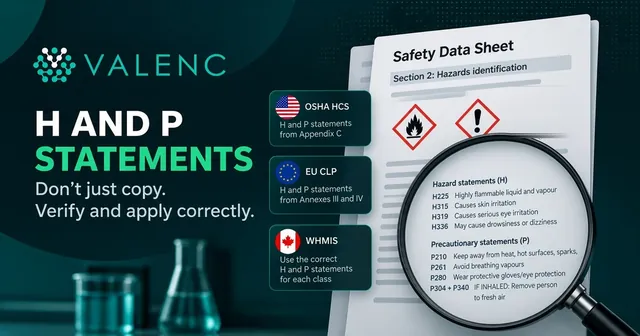
Phosphorus pentasulfide (CAS 1314-80-3) has a harmonized classification in the EU. Here are the statements that come with it:
- H228: Flammable solid.
- H260: In contact with water releases flammable gases which may ignite spontaneously.
- H302 + H332: Harmful if swallowed or if inhaled.
- H400: Very toxic to aquatic life.
- EUH029: Contact with water liberates toxic gas.
Look at the water hazard. It shows up twice, once for flammable gas (H260) and once for toxic gas (EUH029). Those are two different hazards, and they get two different statements.
Now look at the toxicity. The solid is “harmful if inhaled.” Hydrogen sulfide, the gas it makes with water, is classified in the EU as “fatal if inhaled” (H330). The reaction product is the more serious hazard, and it is not the one the product’s own toxicity classification describes.
The gap
OSHA’s Hazard Communication Standard has a class for the first hazard. Appendix B.12 covers chemicals which, in contact with water, emit flammable gases.
There isn’t a class for the second hazard. OSHA doesn’t have a hazard class for materials that release a toxic gas when they come into contact with water, and EUH029 is an EU supplemental statement without an OSHA equivalent.
So, on a US label that only lists classified hazards, the water warning for a material like this focuses on fire. There’s nothing that requires the label to mention the gas is also toxic.
Where it goes on a US SDS
The 2024 update to the standard gives authors two places for it, and both are in Section 2:
- Reaction products. Under 29 CFR 1910.1200(d)(1)(ii), classification has to consider “chemical reaction products associated with known or reasonably anticipated uses or applications.” Appendix D gives these hazards their own line in Section 2.
- Hazards not otherwise classified (HNOC). An adverse effect found during classification that doesn’t meet the criteria of any hazard class. These are also described in Section 2.
Deciding which category fits is up to the author’s judgment. What stands out to me is that paragraph (f)(1) says hazards of either type “do not have to be addressed on the container.”
This means the SDS might be the only place where the toxic gas hazard is mentioned. If it only shows up in Section 10, someone reading Section 2 before starting a job might see “flammable gas” and not look any further.
What the SDSs actually say
To see how this works in practice, I looked up public SDSs for phosphorus pentasulfide from five different suppliers. None of these are connected to the Deer Park incident. They’re just public examples of the same material, mostly from lab chemical suppliers.
All of them clearly say to keep the product away from water. Where they differ is in how they address the toxic gas:
- Four of the five say in the hazards section that contact with water liberates a toxic gas. One mentions only flammable gas.
- Only one says that the gas water produces is hydrogen sulfide. It is a 2007 MSDS, written before GHS, and it says so in plain words in the emergency overview: “Reacts with water to form hydrogen sulfide, sulfur dioxide, and phosphoric acid.”
- Two never use the words hydrogen sulfide anywhere in the document.
- Two mention hydrogen sulfide only in a toxicology paragraph that never says the product makes it with water.
So this rang true for me. If you already know the chemistry, you know what to expect. But if you rely on a current SDS to tell you which gas is produced, four out of five won’t say. The oldest document was actually the clearest.
A closer look at one of them
Here is the most recent of the five, a US SDS from a major laboratory chemical supplier, revised in August 2026.
It gets the most important thing right. Section 2 carries the line “Contact with water liberates toxic gas” under other hazards. Section 6 says to take the material up dry, and Section 7 says to keep the workplace dry and never let the product touch water.
Now read it as someone planning a job:
- The gas is never named where you’d look for it. Section 2 says “toxic gas.” Section 10 warns of a risk of explosion with water. Hydrogen sulfide appears only in Section 11, in a paragraph about its health effects that never says the product makes it with water.
- Section 10 has blanks. Incompatible materials reads “No data available,” and hazardous decomposition products points only to combustion products in a fire.
- Section 5 sends two messages about water. Water is listed as an unsuitable extinguishing medium, and a few lines later the SDS says to knock down gases and vapours with a water spray jet.
- The toxic gas line is not among the label hazard statements. That is what the rule allows.
I’m not criticizing this supplier. They included the warning in Section 2, which goes beyond what the label rules require. My point is that a reader has to connect a line in Section 2 with a paragraph in Section 11 to find out which gas it is, and there’s nothing that prompts them to do that.
Why this matters most during non-routine work
Most people encounter a product during normal operations, when it stays dry. But maintenance, cleaning a vessel, opening a line, or restarting idle equipment can introduce water where it usually doesn’t go. This could be from wash water, steam, rain through an open hatch, or humid air in equipment that’s been sitting.
Employers are required to inform employees about the hazards of non-routine tasks under 29 CFR 1910.1200(e)(1)(ii). The people who write job plans and permits often begin with the SDS.
Here’s what I think
If your product makes a toxic gas when it meets water, I’d do five things:
- Say it in Section 2, in plain words, and name the gas.
- Name the gas again in Section 10, under hazardous reactions and hazardous decomposition products. “Toxic fumes” isn’t enough.
- List water and moisture under conditions to avoid and incompatible materials.
- Make Sections 5, 6 and 7 agree with that. Say whether water can be used on a fire or a spill, how the product is kept dry, and what to think about before equipment that held it is opened, washed or steamed.
- Consider putting the warning on the label as supplemental information. The rule doesn’t require it, but nothing stops you.
There’s also a timing reason to review this now. Manufacturers, importers, and distributors have until November 19, 2027, to update mixture SDSs to meet the 2024 requirements. If you’re already reopening those files, include water reactivity in your review.
This is just my interpretation of the rule, not legal advice. At Valenc, we build SDS authoring software, so I spend a lot of time thinking about these issues, but you don’t need our software to do this check. Take a look at your water-reactive products this week and read Section 2 as if you’re about to open a vessel.
Sources
- FOX 26 Houston: Deer Park shelter-in-place, Lubrizol Deer Park
- ABC13: Deer Park shelter-in-place lifted after hydrogen sulfide gas release
- 12News/KHOU 11 via Yahoo News: shelter-in-place lifted after hydrogen sulfide release
- OSHA Hazard Communication Standard, 29 CFR 1910.1200
- OSHA 1910.1200 Appendix B, Physical Hazard Criteria
- OSHA 1910.1200 Appendix D, Safety Data Sheets
- EU CLP Regulation (EC) No 1272/2008, Annex VI, entries for diphosphorus pentasulphide and hydrogen sulphide
- Five publicly available SDSs for phosphorus pentasulfide (CAS 1314-80-3) from five suppliers, dated 2007 to 2026
See SDS authoring on your own products: one classification record behind every section and the label.