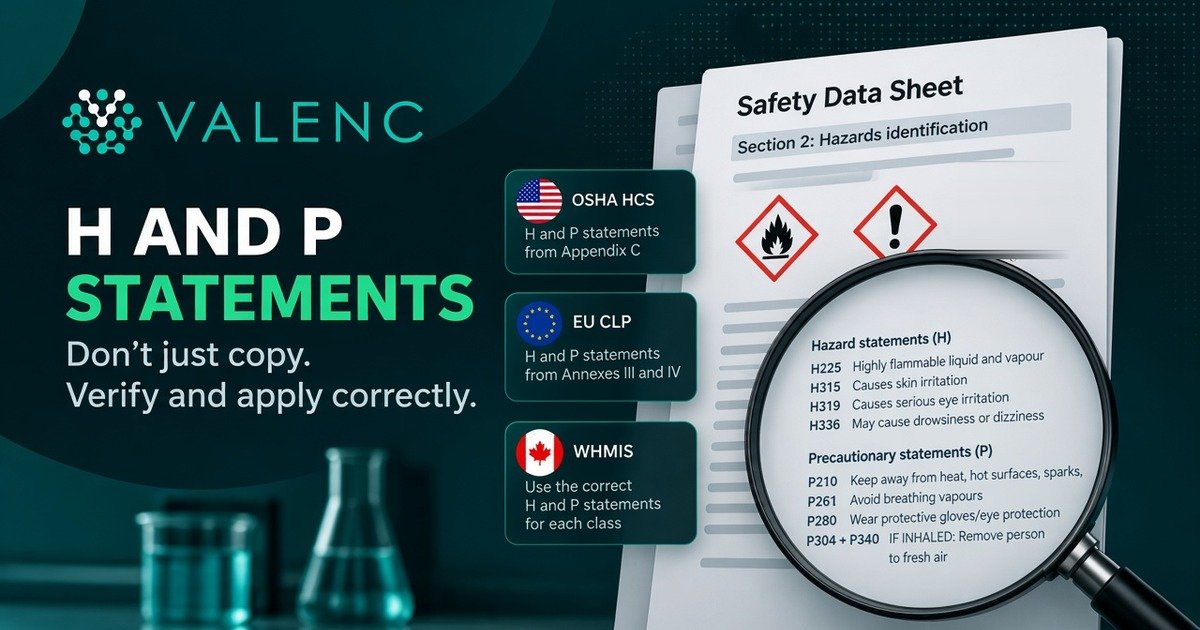
Hazard and precautionary statements depend on your product's classification and the applicable market rules. If your product differs from the supplier's, is used in a mixture, or the supplier SDS is for another jurisdiction, you may need to revise the statements.
It is easy to overlook this risk because H and P statements appear standardized. While the wording is standardized, selecting the appropriate statements for your product is not.
The practical rule
Use the supplier SDS as a reference. Always verify the classification, jurisdiction, and product use before including any hazard or precautionary statement in your own SDS or label.
What are H and P statements?
H statements describe the nature and, where applicable, the degree of a hazard. P statements describe the measures used to prevent or reduce harm from exposure, handling, storage, response, or disposal.
H and P codes are helpful shorthand, but they are not sufficient on their own. The required output is the statement text appropriate for the product's classification and market.
Canada's Hazardous Products Regulations (section 3(2)) say the alphanumeric codes need not appear on the label, while the prescribed statement wording must. EU CLP also requires the relevant statement wording, while OSHA Appendix C assigns the actual phrases that must be used.
Copying a code from a supplier document does not ensure compliance. You must confirm that each statement applies to your product.
Hazard statements follow classification
Hazard statements are typically easier to review because they follow directly from the classification. The applicable rule assigns the hazard statement. Change the classification and the statement can change with it.
Under OSHA, Appendix C assigns the signal word, hazard statement, pictogram, and precautionary statements for each HCS hazard class and category. All applicable hazard statements generally appear, although OSHA allows them to be combined and, in limited cases, omitted when the responsible party can demonstrate that all or part of a statement is inappropriate to the specific substance or mixture.
Canada is stricter about omission. Prescribed hazard statements generally have to remain unless a specific exemption applies, although statements can be combined when the combined wording communicates the same information.
Under EU CLP, the relevant hazard statements follow the classification and use the wording set by the regulation (CLP Article 27). All hazard statements resulting from the classification appear on the label unless there is evident duplication or redundancy.
If your classification differs from the supplier's, your H statements should not automatically match theirs.
Precautionary statements need more judgment
Copying P statements without review can cause even bigger problems.
Precautionary statements are not chosen solely based on the presence of a hazard. Selection may depend on use, handling, storage, packaging, or how the product is supplied.
OSHA's Appendix C includes slash options, brackets, ellipses, and conditional instructions. Those are there because the preparer has to choose the wording that fits the product. OSHA also allows similar precautionary statements to be combined or consolidated, requires the more stringent statement where similar precautions overlap, and allows a statement to be omitted when it can be shown to be inappropriate to the specific product.
Canada uses the same general idea but with its own HPR rules. Precautionary statements assigned to the product must be provided unless they are not applicable under the normal conditions of use, handling, and storage or another exemption applies. The supplier can combine statements.
In the EU, precautionary statements are selected based on the hazard statements, the intended or identified uses, and the conditions for use (CLP Article 28(1)). Clearly redundant or unnecessary statements are omitted (CLP Article 28(1)), and not more than six appear on the label unless more are necessary to reflect the nature and severity of the hazards (CLP Article 28(3)). The limit applies to the label, not the SDS.
A supplier's P statements may be appropriate for their product but unsuitable for yours.
Why copying a supplier SDS can fail
1. The supplier material is not your finished product
A raw material SDS describes only the raw material. Once incorporated into a formulation, the finished mixture must be classified accordingly, and its H and P statements should reflect that classification.
This is especially important if ingredient concentrations cross classification thresholds or if mixture rules alter the final category.
2. The supplier SDS may be written for another market
A U.S., Canadian, and EU SDS may all use GHS language but still have different statement requirements.
The supplier may also follow a different GHS revision, transition date, or include a local hazard class not present in your target jurisdiction.
3. The supplier's precautionary choices may not fit your use
Statements regarding protective equipment, ventilation, storage, response, or disposal depend on how the product is used and supplied.
If the supplier chose a specific option from a slash-separated P statement, that choice may not be appropriate for your finished product.
4. The supplier document may still contain unfinished instruction text
A P statement containing a slash, ellipsis, bracketed option, or supplier-specific instruction may not be finalized correctly.
OSHA Appendix C (section C.2.4.2) gives an example of these choices. A statement such as "protective gloves/protective clothing/eye protection/face protection" is not meant to be copied mechanically. The preparer is expected to select the applicable protection.
5. A classification update can leave old statements behind
If a product's category or classification criteria change, review Section 2 and the label together.
Updating the hazard class without revising the H and P statements results in an internally inconsistent SDS.
The US, Canada, and EU do not treat the statements in exactly the same way
| Issue | United States | Canada | European Union |
|---|---|---|---|
| Hazard statements | All applicable statements generally required; may be combined; may be omitted if demonstrated inappropriate to the specific chemical | Prescribed statements generally required; omission is limited to specific exemptions; statements may be combined | Relevant H statements follow CLP classification; duplication or redundancy can be removed |
| Precautionary statements | Assigned by Appendix C; choices and conditions must be resolved; may be consolidated or omitted if inappropriate | Assigned under HPR/GHS; may be combined; may be omitted when not applicable under normal use, handling, and storage or under an exemption | Selected based on hazards, intended/identified uses, and conditions for use; redundant or unnecessary statements are omitted |
| Codes | OSHA compliance is based on the required statement text, not copying an H/P code | Alphanumeric codes need not appear. The prescribed statement wording must. | Codes identify the statements, but the required wording must appear in the appropriate language |
| Local additions | HCS-specific hazards and supplemental information can apply | WHMIS includes Canadian hazard classes and Schedule 5 requirements | EUH supplemental statements can apply in addition to GHS H statements |
A few statement-level checks reviewers should make
Before approving Section 2 or the product label, ensure statements are based on the classification, not copied text.
Does every H statement match a current hazard class and category for this product?
Are any hazard statements left over from an older classification?
Were any statements copied from a supplier material that is not the finished product?
Have slash options, brackets, ellipses, and supplier instructions in P statements been resolved?
Do the precautionary statements make sense for the product's intended use, handling, storage, and packaging?
Have duplicate or redundant statements been handled according to the local rules?
Are any local statements required, such as Canadian non-GHS hazard wording or EU supplemental EUH statements?
Is the wording in the language required for the target market?
Do Section 2 and the label tell the same hazard story where the regulation requires them to?
If any of these checks fail, do not simply edit the phrase. Revisit the classification and relevant statement rules.
Supplier SDS data should feed the decision, not replace it
A supplier SDS remains a valuable input. It provides ingredient classifications, composition data, physical properties, transport information, and the supplier's hazard communication.
Valenc's SDS Indexing workflow treats the supplier SDS as source data. The PDF is extracted and reviewed, and approved information becomes structured material data for downstream use.
Next, classify the product under the relevant jurisdiction's rules. Once approved, derive the H and P statements from this classification, not from the original PDF.
This is why Valenc separates GHS classification from SDS authoring. Classification determines the hazard, while authoring uses the approved classification and a curated phrase library to build the SDS for the target market and language.
For U.S. teams working through HCS 2024 changes, Valenc's existing HCS 2024 checklist is a useful companion when a classification or statement set needs to be revisited.
While statement text is standardized, the decision must be based on the specific product.
Standardized H and P statements improve hazard communication across markets, but SDS authoring should not become a copy-and-paste process.
The recommended workflow is straightforward: use the supplier SDS as evidence, classify the product according to applicable rules, and select the appropriate hazard and precautionary statements.
If the product, market, use, or classification changes, review the statements again.
Technical verification: Primary regulatory sources checked October 5 to 16, 2026: OSHA Appendix C, Canada's Hazardous Products Regulations, and EU CLP.