If you ship chemicals to Mexico or your customers operate plants there, you must comply with NOM-018-STPS-2015. This official standard governs the identification and communication of chemical hazards in the workplace. It defines the required contents of safety data sheets, labeling and signage requirements, and worker training standards.
This article explains the standard in clear terms and concludes with a brief pre-shipment checklist.
What NOM-018-STPS-2015 is
NOM-018-STPS-2015 is issued by Mexico's labor ministry, the Secretaría del Trabajo y Previsión Social (STPS). Its full name translates roughly as "Harmonized system for the identification and communication of hazards and risks from hazardous chemical substances in workplaces."
It was published in the Diario Oficial de la Federación (DOF) on October 9, 2015. Under its first transitory article, it took effect three years after publication, which puts the start date at October 9, 2018. It replaced the older NOM-018-STPS-2000.
The standard is based on the GHS. Section 16 states it is partially equivalent to the fifth edition of the UN GHS (2013), with adaptations for Mexico. If you are familiar with GHS in the US or EU, much will be recognizable, though specific requirements are unique to Mexico.
Who it applies to
Section 2 says the standard applies across Mexico, to every workplace where hazardous chemical substances are handled. It does not apply to certain finished products, such as pharmaceuticals, food additives, cosmetics, pesticide residues in food, and hazardous waste.
What the standard asks employers to do
Chapter 6 lists the employer's duties. In short, the employer must:
have and put in place the harmonized hazard identification and communication system
have a safety data sheet for every hazardous substance and mixture handled at the site
keep those safety data sheets permanently available to workers where the chemicals are handled
mark containers, shelves, and storage areas with the required hazard signage
inform and train workers on the safety data sheets and signage
give customers the safety data sheets for the hazardous substances and mixtures they sell (6.8)
This requirement is important for suppliers. If you sell into Mexico, your customers will likely request a Spanish safety data sheet.
The HDS requirements
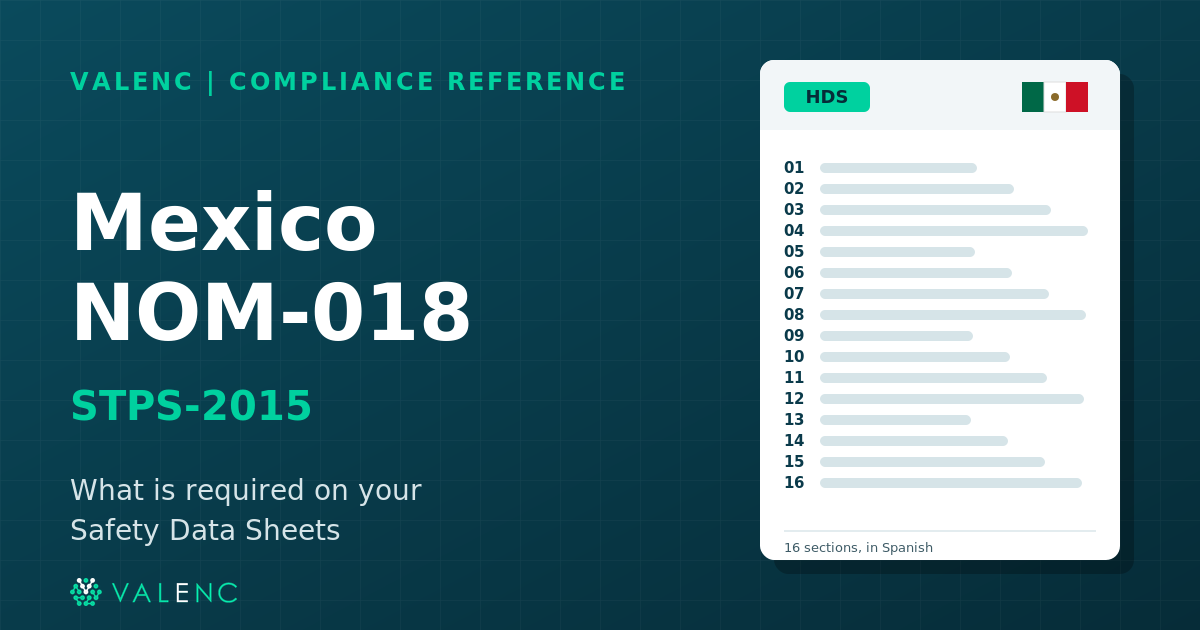
In Mexico, the safety data sheet is called the hoja de datos de seguridad, or HDS. Section 9.1 says the HDS must:
be developed in free format
be prepared or held in Spanish
contain the 16 sections listed in section 9.2
Sections 12 to 15 (ecological information, disposal, transport, and environmental regulatory information) follow what the competent authority sets (section 9.1). Section 9.1 also sets out which ingredients must be listed in Section 3, based on concentration limits for each health hazard class (Table 1 of the standard).
Appendix E provides instructions for preparing the HDS. Information must be in Spanish, clear, concise, and complete. If a property is unavailable, the HDS should state this in the relevant section rather than leave it blank.
Section 9.3 says the HDS must be updated when new information changes the substance's or mixture's GHS classification in a way that changes the safety measures, and when new data or test results are published on possible adverse effects.
Labels and signage
Chapter 10 covers signage and labels. The hazard communication elements are the familiar GHS ones: pictograms, signal words, hazard (H) statements, and precautionary (P) statements. The standard's appendices set them out:
Appendix A: hazard communication elements for physical and health hazards
Appendix B: pictograms
Appendix C: H statements
Appendix D: P statements
Refer to the appendices for precise wording and layout. This article does not address detailed label layout requirements.
Training
Under section 11.1, training must be given to every worker who handles hazardous substances and mixtures, to members of the safety and health committee, and to workers with a role in emergencies. It must happen at least once a year, each time a new hazardous substance or mixture is added, and when the HDS or signage is updated.
Section 11.2 says training must cover, at a minimum, the 16 sections of the HDS and the signage elements in the standard. Section 11.3 asks the employer to keep records of the training given.
A pre-shipment check for exporters
Before a product ships into Mexico, run through this list:
Spanish HDS. Is there a Spanish version of the safety data sheet?
16 sections. Does it contain all 16 sections listed in section 9.2?
Classification. Is the classification based on the GHS criteria the standard uses, and is it current?
Ingredients. Are the Section 3 ingredients listed according to Table 1 concentration limits?
Labels. Are the label elements in Spanish and in line with the appendices?
Date. Is the HDS up to date, given any new hazard data?
Use this checklist as an initial reference. Confirm all details with your Mexican regulatory contact before proceeding.
How Valenc helps
Valenc is an AI-native SDS authoring and chemical compliance platform. SDS authoring is available for Mexico, as well as the US, Canada, the EU, the UK, and the UN. Valenc supports over 25 languages, allowing the same product to have both a Spanish HDS and an English SDS, with drafts generated in minutes.
GHS classification uses a rules engine, providing transparency into how each classification is determined. For extraction and indexing, Valenc reports over 98% field accuracy with per-field confidence metrics.
Valenc is a software platform and does not provide SDS authoring as a service. If you require this service, we can connect you with our partners. For more information, see regions and languages, SDS authoring, and our post on multilingual SDS authoring.
FAQ
Does NOM-018 require a Spanish SDS?
Section 9.1 says the HDS must be prepared or held in Spanish.
What is an HDS?
HDS stands for hoja de datos de seguridad, the Spanish term for the safety data sheet used in NOM-018-STPS-2015.
How many sections must an HDS have?
Sixteen, as listed in section 9.2 of the standard.
How often must training be repeated?
At least once a year, and also when a new hazardous substance or mixture is added or the HDS or signage changes (section 11.1).
This article explains the standard in plain terms. It is not legal advice. Confirm against the current official text before you rely on it.
If you are shipping to Mexico and need to organize your SDS library, Valenc will index up to 100 of your SDSs at no cost. This offer is available to any chemical manufacturer through December 31, 2026. Submit your files through our secure portal, and we will return an index within three business days of receipt.