If you operate a chemical plant, you have dual responsibilities. As a manufacturer, your substance SDSs and shipping labels were due May 19, 2026. As an employer, your workplace must comply by November 20. Below is an overview of the requirements, their connection to common OSHA citations at chemical plants, and guidance on complying with the deadline.
What's due on November 20
The requirement is in 29 CFR 1910.1200(j)(2)(ii). For substances, employers must:
Update alternative workplace labeling used under paragraph (f)(6). In-house labels on workplace containers must reflect the updated hazard information.
Update the hazard communication program referenced in paragraph (h)(1). The written program, chemical inventory, and labeling procedures must comply with the 2024 standard.
Provide additional training under paragraph (h)(3) for newly identified physical or health hazards, or other hazards now covered.
"Substances" refers to single chemicals, not mixtures. Raw materials such as toluene or sodium hydroxide are included this month. Blended products (mixtures) follow later: manufacturers, importers and distributors by November 19, 2027, and employers by May 19, 2028. Since many plants use both, begin by sorting your inventory.
All four HazCom 2024 deadlines
OSHA pushed every date back four months in January 2026 because its guidance for the updated standard wasn't ready (91 FR 1695). Not sure which date applies to you? Use the free HCS 2024 deadline checker.
| Who | Products | Original date | Current date |
|---|---|---|---|
| Manufacturers, importers, distributors | Substances | Jan 19, 2026 | May 19, 2026 |
| Employers | Substances | Jul 20, 2026 | Nov 20, 2026 |
| Manufacturers, importers, distributors | Mixtures | Jul 19, 2027 | Nov 19, 2027 |
| Employers | Mixtures | Jan 19, 2028 | May 19, 2028 |
Until each compliance date, paragraph (j)(4) allows you to follow the 2012 standard, the 2024 standard, or both. After November 20, the 2012 option is no longer available for substances.
What triggers an update
The 2024 standard aligns with GHS Revision 7, revising classification criteria and adding or clarifying hazards such as aerosols, chemicals under pressure, and desensitized explosives. When a supplier reclassifies a substance, its SDS and label are updated. If your workplace labels or training are based on the previous SDS, they must also be updated. Our supplier SDS revision checklist covers how to compare the old and new versions.
Why this deadline matters at chemical plants
The three items due on November 20 are also the most frequently cited HazCom violations at chemical manufacturing facilities.
Valenc analyzed OSHA's public enforcement data for chemical manufacturing (NAICS 325) from 2016 through 2025. OSHA issued 1,409 HazCom citations at these plants, making HazCom the third most-cited standard in the industry. Here's how they break down:
| HazCom requirement | Share of HazCom citations at chemical plants, 2016–2025 |
|---|---|
| Training (h) | 36% |
| Written program (e) | 31% |
| Labels (f) | 20% |
| Safety data sheets (g) | 11% |
| Other | 2% |
Training, the written program, and labels account for nearly 90% of HazCom citations at chemical plants. These are the areas addressed by the November 20 deadline. Nationally, Hazard Communication was OSHA's second most-cited standard in FY2025, with 3,010 violations.
Most citations result from unplanned inspections. From 2021 to 2025, 76% of OSHA inspections at chemical manufacturers were triggered by a complaint, referral, accident, or fatality. Inspectors can check whether your labels and training match current SDSs. A serious violation can result in penalties up to $16,550 per citation.
A plan for the next three weeks
You do not need to rebuild your HazCom program. Identify which substances have changed and update labels, the program, and training accordingly.
Week 1: find what changed
- Review your chemical inventory and identify all single-substance materials, including raw materials, solvents, cleaners, and maintenance chemicals.
- For each substance, confirm you have the supplier's current SDS. If an SDS doesn't reflect HazCom 2024, request an updated version from the supplier.
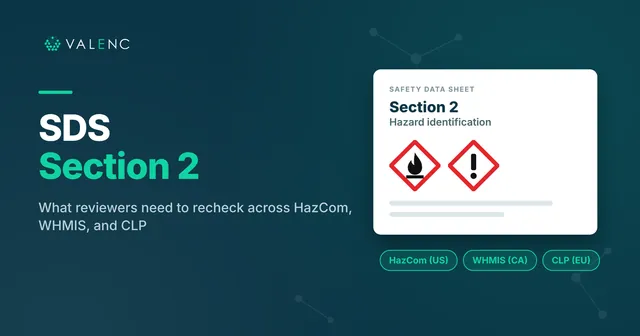
- Compare old and new SDSs, focusing on Section 2. Look for new hazard classes, pictograms, signal words, or hazard statements.
- If you manufacture or import substances, confirm that your own SDSs and shipping labels were updated by May 19.
Week 2: update labels and the written program
- Relabel workplace containers for each substance with updated hazard information. Review secondary containers and any in-house labeling systems.
- Update the written HazCom program to reference the 2024 standard (29 CFR 1910.1200 as amended in May 2024). Update the chemical inventory and outline your approach for the mixtures deadline in 2028.
- Assign responsibility for ongoing SDS updates to ensure new supplier SDSs are incorporated into labels and training promptly, without waiting for a deadline.
Week 3: train and document
- Train affected employees on any newly identified hazards, new pictograms, or revised precautions for the substances they handle.
- Brief supervisors so they can answer questions on the floor.
- Document who was trained, the date of training, and the topics covered. Maintain these records with the updated program.
Note that many plants may find most substance SDSs did not change classification. This is acceptable. However, document your review, as "we reviewed it and nothing changed" is a defensible response, while "we did not check" is not.
For a full list of what changed in the 2024 rule, see our HCS 2024 compliance checklist.
Frequently asked questions
What is the HazCom 2024 deadline for employers?
November 20, 2026 for substances and May 19, 2028 for mixtures. Both dates reflect OSHA's four-month extension published in January 2026.
What do employers have to do by November 20, 2026?
Update alternative workplace labeling, update the hazard communication program and train employees on any newly identified hazards, all for substances. The requirement is in 29 CFR 1910.1200(j)(2)(ii).
Does the November 20 deadline apply to mixtures?
No. Mixtures follow later dates: November 19, 2027 for manufacturers, importers and distributors, and May 19, 2028 for employers.
Do I have to retrain every employee?
No. The rule requires additional training for newly identified hazards. Employees who handle substances whose hazards changed need training on those changes.
What if my supplier hasn't sent an updated SDS?
Suppliers' substance deadline was May 19, 2026. Request the current SDS in writing and keep a record of the request. You're still responsible for your workplace labels and training.
I'm a chemical manufacturer. Does this apply to me?
Yes, as an employer of the people in your plant. Your May 19 deadline covered the SDSs and labels you ship. November 20 covers your own workplace.
Get ready for the mixtures deadline next
November 20 is the less complex deadline. The more challenging requirement is November 19, 2027, when all mixture SDSs you ship must comply with HazCom 2024. For most formulators, this will require reclassifying and updating much of their SDS library within approximately 12 months. Our guide to the 2027 mixtures deadline covers the data to start gathering now.
Valenc is an SDS authoring platform for chemical manufacturers. It classifies your formulas using a rules engine aligned with HazCom 2024, GHS, WHMIS, CLP, and NOM-018, and generates SDSs and labels for the US, Canada, Mexico, the EU, and the UK. Request a demo, or submit up to 100 SDSs for free indexing, available through December 31, 2026, to assess your current library.
This article provides general information and does not constitute legal advice. Please consult the regulation text for your specific situation.
References
Safety+Health Magazine: OSHA reveals final Top 10 data for FY 2025
OSHA: 2026 annual adjustments to OSHA civil penalties, May 21, 2026
OSHA inspection and violation data, U.S. Department of Labor enforcement database, downloaded October 31–November 1, 2026. Valenc analysis of NAICS 325 citations issued from inspections opened 2016–2025; counts citations to 29 CFR 1910.1200, including state-plan inspections that cite it; state-specific equivalents such as Cal/OSHA §5194 are not included.